Oliver had a habit that his teacher called "daydreaming" and his grandfather called "a gift." He would sit at his desk or at the dinner table or on the garden wall, close his eyes, and go somewhere else entirely. When he opened them again, he was always a little surprised to find himself back in the ordinary world.
One afternoon in early summer, Oliver was sitting in the garden behind his house, frustrated because the soil was hard and dry and nothing would grow. He had planted seeds three weeks ago — beans, sunflowers, and one ambitious pumpkin — and not a single green shoot had appeared. He sat with his chin in his hands and, without really meaning to, closed his eyes.
When he opened them, the garden was different.
Not different in any way he could immediately explain. The fence was in the same place. The stone path wound around the same way. But everything was vivid and alive in a way it had not been before. The grass between the stones was a green so bright it almost hurt to look at. Flowers he had never planted were blooming in corners he had thought were bare. The air smelled of rain and honey.
Oliver stood up very slowly, afraid that if he moved too quickly the whole thing would disappear.
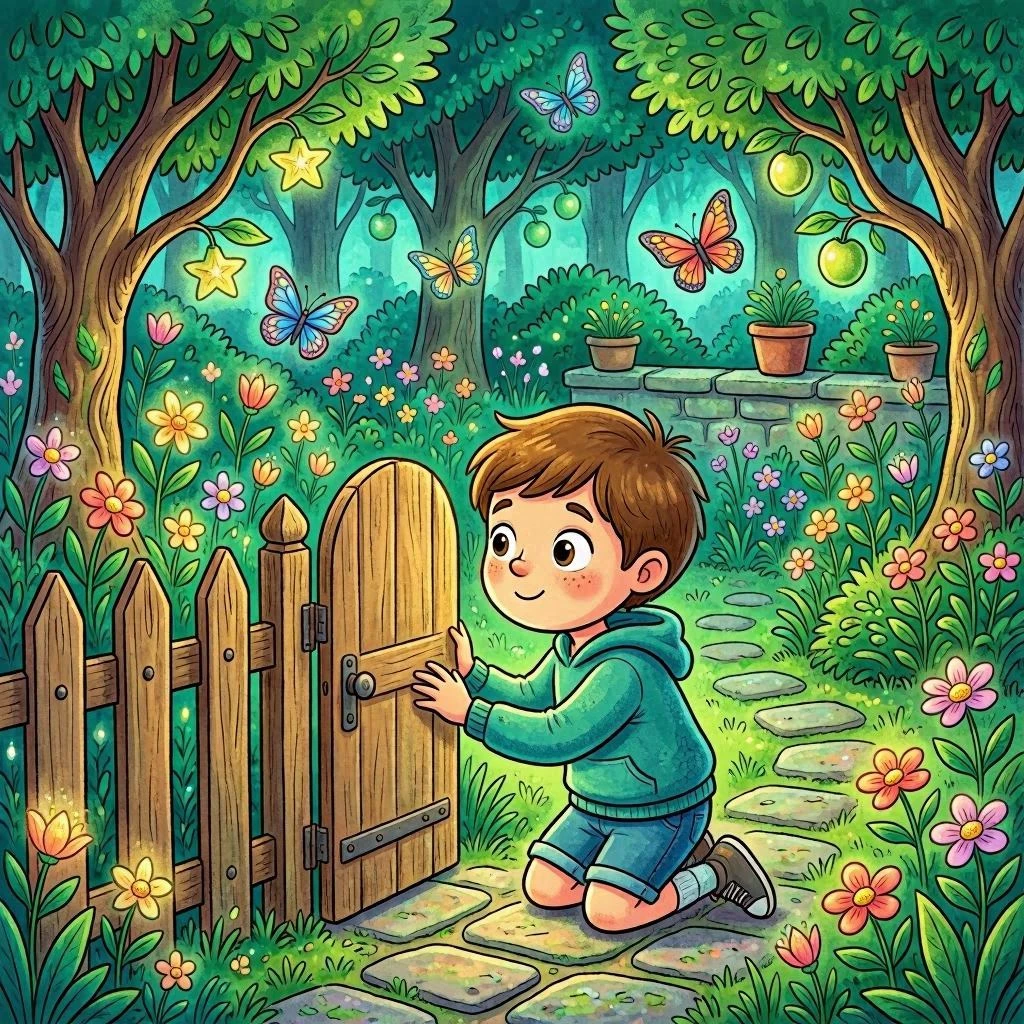
He walked along the stone path and found, in the back corner of the garden, a small wooden door set into the fence that he had never noticed before. He was almost certain it had not been there yesterday. He pushed it open.
Beyond the door was a garden within the garden — a hidden space no larger than his bedroom but so full of growing things that it seemed to go on much further than it should have. Climbing roses wound up trellises that disappeared into mist. Strawberries clustered in red handfuls along the ground. In the center, a single tree no taller than Oliver himself was hung with small, glowing fruits that were neither quite apples nor quite stars.
Oliver reached out and took one. It was warm in his hand, and it pulsed gently, like a heartbeat.
He sat down under the little tree and held the fruit in his palm and looked around him. A large butterfly with wings like stained glass landed on his knee and opened and closed its wings slowly, as though breathing. Bees moved through the flowers with a sound like a quiet, happy conversation. A lizard on a warm stone watched him with an eye like a bead of amber.
Oliver felt, very strongly, that this place was real. More real, in some ways, than the dry ordinary garden on the other side of the door. But he also understood — without being told, the way you sometimes understand things in dreams — that it was real because he had imagined it. Not invented it, exactly. Discovered it. The way you discover a door that was always there.
He went back the next day, and the garden was there. He went back the day after, and the day after that. Each time he came, the garden had grown a little. New paths appeared. A small fountain trickled in a corner. A family of hedgehogs moved in under the roots of the glowing tree.
Oliver did not tell anyone about the garden for a long time. It was not that he was selfish or secretive. He simply felt that some discoveries need time to grow solid before you can share them, the way a seedling needs weeks underground before it can face the sun.
When he finally brought his grandfather to the gate and pushed it open, the old man stood very still for a long moment, looking at the roses and the fruit tree and the butterfly and the bees. Then he turned to him with shining eyes.
"I used to have a garden like this," he said softly, "when I was your age."
Oliver took his hand. The garden had grown large enough for two, just as he had somehow known it would.