Theo had been collecting clouds since he was four years old.
Not imaginary clouds, not drawings of clouds — real ones, actual wisps and curls of water vapor that he caught in glass jars when they drifted low enough through the valley on misty mornings. The jars lined his windowsill in order of color: pearl white, silver gray, the faint rosy tint of a cloud that had caught the sunrise, the deep bruised purple of one that had been near a thunderstorm.
Most people in the village of Arvel thought this was an unusual hobby, which it was. Theo's father accepted it with the calm of a man who had also accepted that his son named his shoes and believed that trees could hear music. His younger brother Toby thought the cloud jars were the most wonderful things in the world, and sometimes he sat by the window and watched them slowly dissolve into nothing, because clouds, of course, cannot be kept forever.
That was the sad part of the collection. No matter how carefully he sealed the jars, the clouds always faded within a few days. He had to keep collecting new ones.
One summer the valley had a drought. It was the worst anyone could remember. The river shrank to a trickle. The farmer's fields cracked into hard brown tiles. The apple trees dropped their unripe fruit. The village well dropped so low that people were rationing their water.
Theo watched this happen with his particular kind of thoughtful silence. He stood by his window and looked at the clear, empty sky and then looked at his jars.
He had seventeen clouds in jars at the moment. They were a collection of months: an autumn mist, a spring fog, two clouds from a morning in early winter, and one very special one — a full, heavy cloud with gray edges that he had caught the previous autumn just before it rained. He had kept that one sealed very carefully. He could feel, when he held it, that it still wanted to rain.
He carried that jar to the top of the hill at the north end of the valley, the highest point for miles, where the sky felt closer and the wind came straight off the mountains.
He opened the jar.
The cloud came out slowly at first, the way a cat leaves a room — unhurried, aware of itself. Then the wind caught it and it expanded, doubled, tripled, pulled moisture from the air and grew and grew until it was a real cloud, a proper cloud, the kind that darkens the ground below with its shadow.
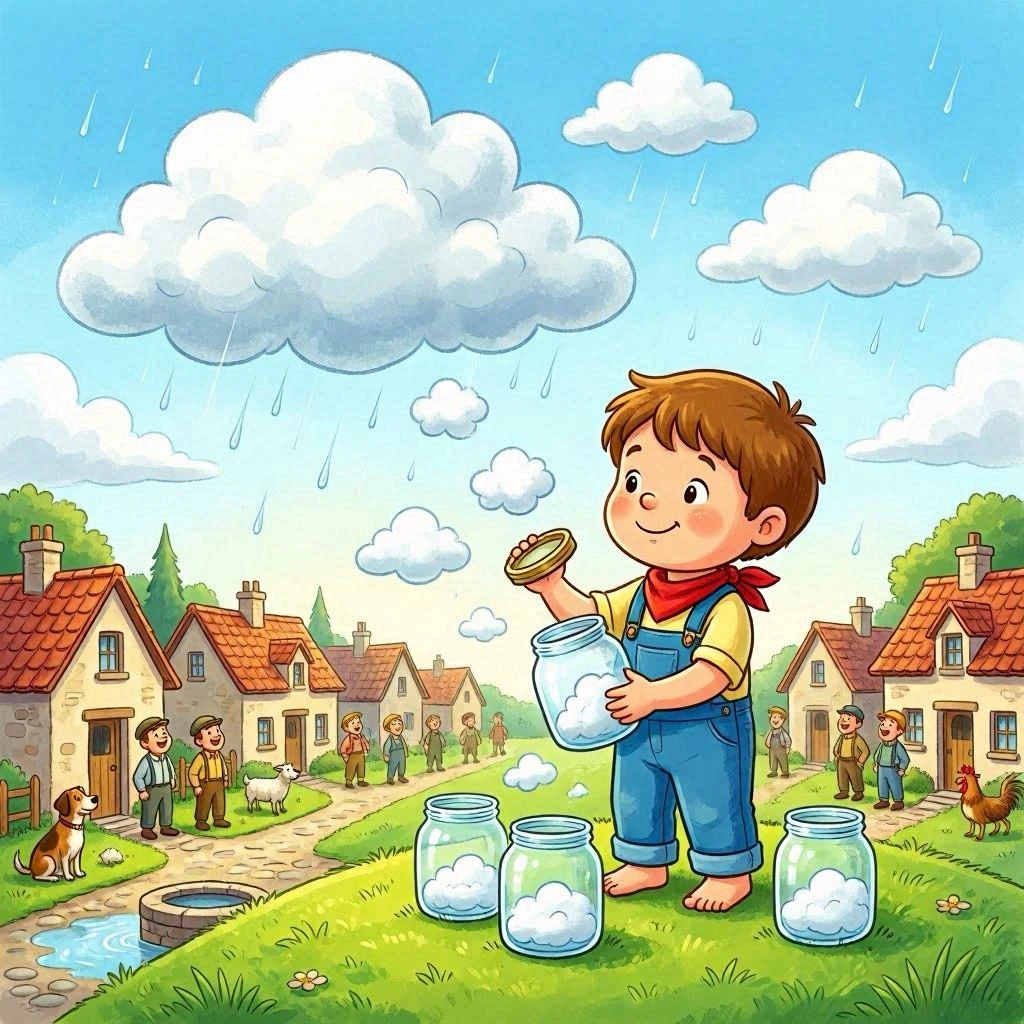
Then Theo opened the others. He opened all seventeen jars, one after another, and the clouds joined the first one, and they merged and grew, and a wind came up that Theo had not expected, and the cloud above the valley became something enormous and dark and wonderful.
When the rain came, it came hard and warm and thorough, the way summer rain does when it has been saving itself for a while. People ran out of their houses and stood in it with their faces turned up. The farmer danced in his cracking field. Toby stood in the garden with his arms out and spun until he fell over. The river, by evening, was running again.
Theo stood on the hill through all of it, wet to the bone, watching his collection dissolve into the earth. Every jar was empty now. Months of patient collecting, gone in an afternoon.
He did not mind.
When he came home, Toby met him at the door. He was still glowing from the rain. "You gave away your whole collection," he said.
"I can collect more," said Theo.
"But you loved those ones."
"I know," he said. "That's why it worked."
He was not sure, later, if he truly understood why he had said that. But he felt it was true. Some things have to be given away to become what they were meant to be. A cloud kept in a jar is just a curiosity. A cloud set free can change a whole valley.
He started collecting again the next morning.