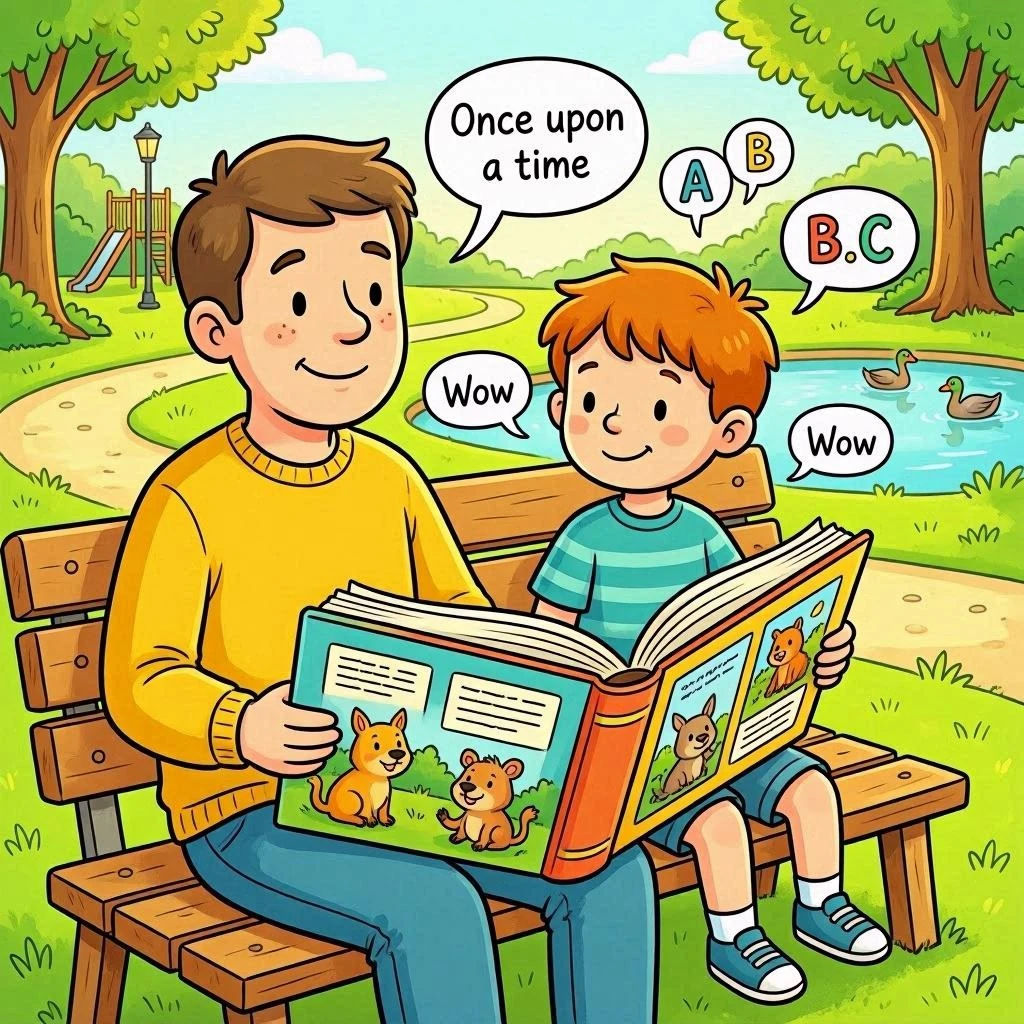
Let's begin with what building a reading habit at home does not require. It does not require a dedicated reading nook with a sheepskin rug and a curated selection of award-winning picture books. It does not require a parent who has a degree in literature, a gift for voices, or a calm and meditative approach to bedtime. It does not require an hour of unhurried time at the end of the day. It does not require silence, perfect lighting, or children who sit still.
Most of the parents who describe raising voracious readers did not have ideal conditions. They had ordinary chaotic lives: dinners that ran late, work calls that didn't end, siblings who wouldn't stop arguing, children who were sometimes overtired and resistant. What they had was a consistent intention — a decision, made and remade every day, that books would be part of family life, even imperfectly, even briefly, even when nobody particularly felt like it. That consistency, not the conditions, is what builds a reading culture.
Starting With What You Have
The single biggest obstacle to establishing a reading habit is the belief that you need more than you have. More time. More energy. More books. More skill as a reader. This belief, while understandable, is the enemy of beginning. The research on how reading habits develop in children is very clear on this point: frequency matters more than duration. A child who hears five minutes of reading every day gets far more benefit than a child who hears forty-five minutes on Saturdays only.
This is genuinely good news for busy parents. Five minutes is almost always achievable. Five minutes before a sibling pick-up, five minutes at the breakfast table, five minutes in the car before going into the grocery store — books can be read in fragments, and children, who are more adaptable than we sometimes give them credit for, will absorb and enjoy those fragments. The accumulation of five-minute sessions across a year represents hundreds of books and thousands of words. It is not a consolation prize. It is a legitimate reading life.
The Library as Infrastructure
One practical change that makes an enormous difference to families who want to read more but struggle to maintain momentum is developing a genuine relationship with the public library. Not a once-a-month trip, but a weekly or even twice-weekly habit — a regular stop that the children come to expect and look forward to. Libraries have a specific psychological advantage over home book collections: they offer novelty. Children who might resist a book they have seen on the shelf for months will often immediately engage with a book that is new and borrowed and slightly mysterious.
The library also solves the budget problem that many families face. Building a home collection of quality children's books is expensive, and it should not be a prerequisite for a rich reading life. The family that visits the library every week and comes home with a bag of books is doing exactly the right thing, regardless of how few books they own.
The Bedtime Anchor
For most families, the single most reliable place to anchor a daily reading habit is the twenty minutes before sleep. This works for several reasons beyond mere convenience. Children are naturally more receptive at the end of the day, when the stimulation of screens and outdoor play and social interaction has wound down. The transition to quiet makes their minds more open to the internal world of story. The darkness gathering outside the window, the warmth of a lamp, the proximity of a parent — all of these create conditions that make reading feel safe and desirable.
The bedtime reading session also has a powerful Pavlovian quality. After a few weeks of consistent practice, the book becomes a cue for settling. Children who know that the book comes after the bath and before the lights go out begin to calm themselves in anticipation of that sequence. Parents who have struggled with difficult bedtime transitions often report that the introduction of a consistent bedtime reading ritual is one of the most effective tools they have found. The book is not only good for language development. It is also, practically speaking, a sleep aid.
What to Do When Children Resist
Most parents encounter periods when children do not want to be read to — when the book is pushed away, when attention wanders immediately, when the child announces that reading is boring. This is normal, and it is not a reason to abandon the habit. It is usually a reason to change the book.
The most common reason children resist reading is that the book in their hands does not engage them. This seems obvious, but parents are often surprised by how much their own taste diverges from their child's. You may love gentle, lyrical picture books and find that your six-year-old is completely unmoved by them. You may discover that the only books your child will sit still for are books about trucks, or dinosaurs, or disgusting bodily functions, or slapstick comedy that you find entirely charmless. This is fine. It is better than fine. A child who is deeply engaged with a book about farts is a child who is learning to love reading. Follow their interest, even when it leads you somewhere you did not expect.
Building Beyond Bedtime
As children grow and reading becomes more established in family life, there are natural ways to expand the habit beyond the bedtime session. Reading in the car — audiobooks, for families who commute — is one of the most underused resources available to busy parents. A long drive that would otherwise be restless and fragmented can become a shared narrative experience. Many families report that their children's most beloved books were ones they first encountered through an audiobook played during a family road trip.
Reading during transitions is another opportunity. The wait at the doctor's office, the half-hour before a sporting event, the queue at the airport — these are all moments that can be filled with books if a book is always close at hand. Putting a book in every bag, keeping one in the car, having a stack accessible in the kitchen, removes the friction of searching when a moment appears. The habit, like any habit, survives on the elimination of barriers.
Modeling Reading as a Practice
Children do not only learn from what we do for them. They learn from what they see us do. A parent who reads — who is seen reading for pleasure, who talks about books they are enjoying, who borrows books from the library alongside the children — sends a powerful message about the value of reading that no instruction or incentive can replicate. You do not need to perform your reading life for your children. You simply need to have one.
This does not mean you must become a literary person if you are not already one. It means finding whatever you genuinely love to read — crime novels, biographies, gardening books, sports journalism, science writing — and reading it where your children can see you. The parent absorbed in a book is teaching their child something that no reading log or school requirement can teach: that reading is something adults choose to do with their free time because it genuinely matters to them.
That message, delivered quietly and consistently over years, is the foundation of a reading culture at home. And a reading culture at home is one of the greatest gifts you can give your child — not because it will make them perform better on tests, though it may, but because it will give them, for the rest of their lives, a world they can always return to: the world inside a book.