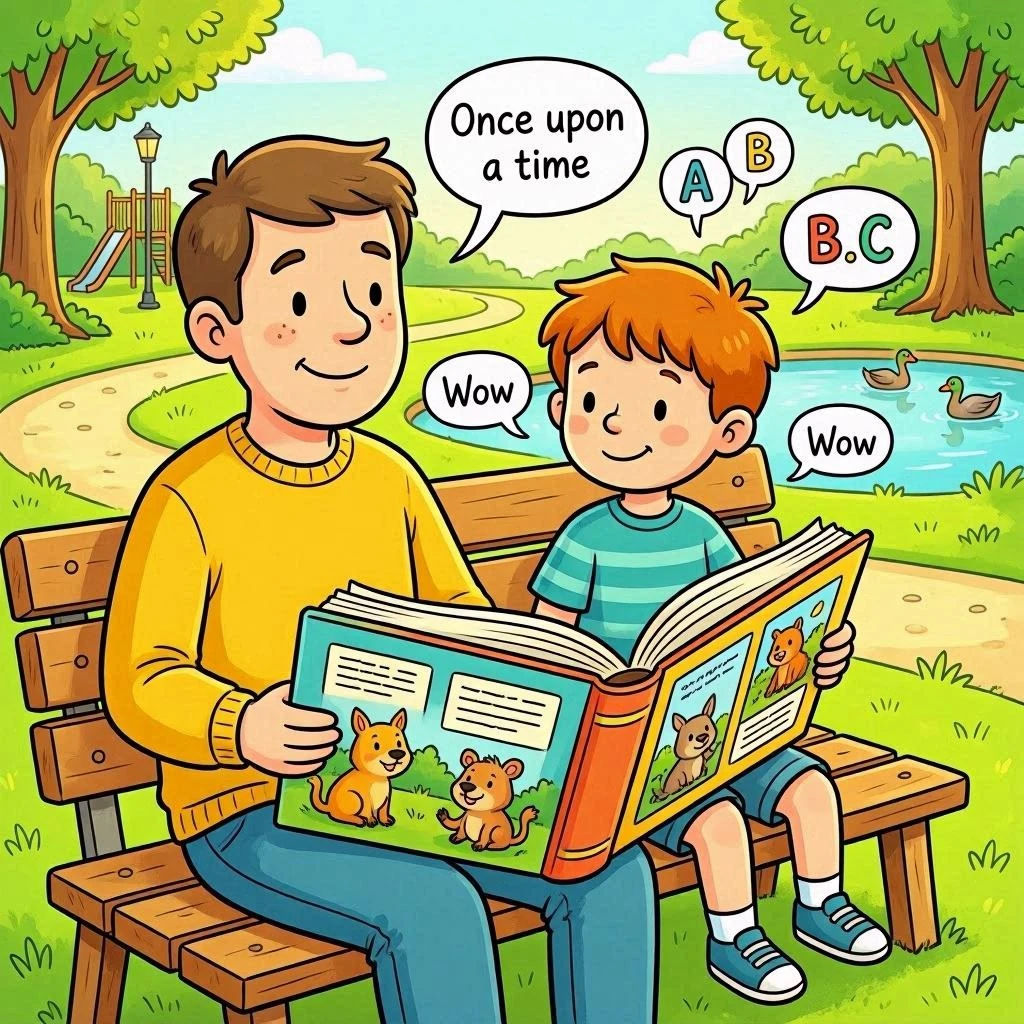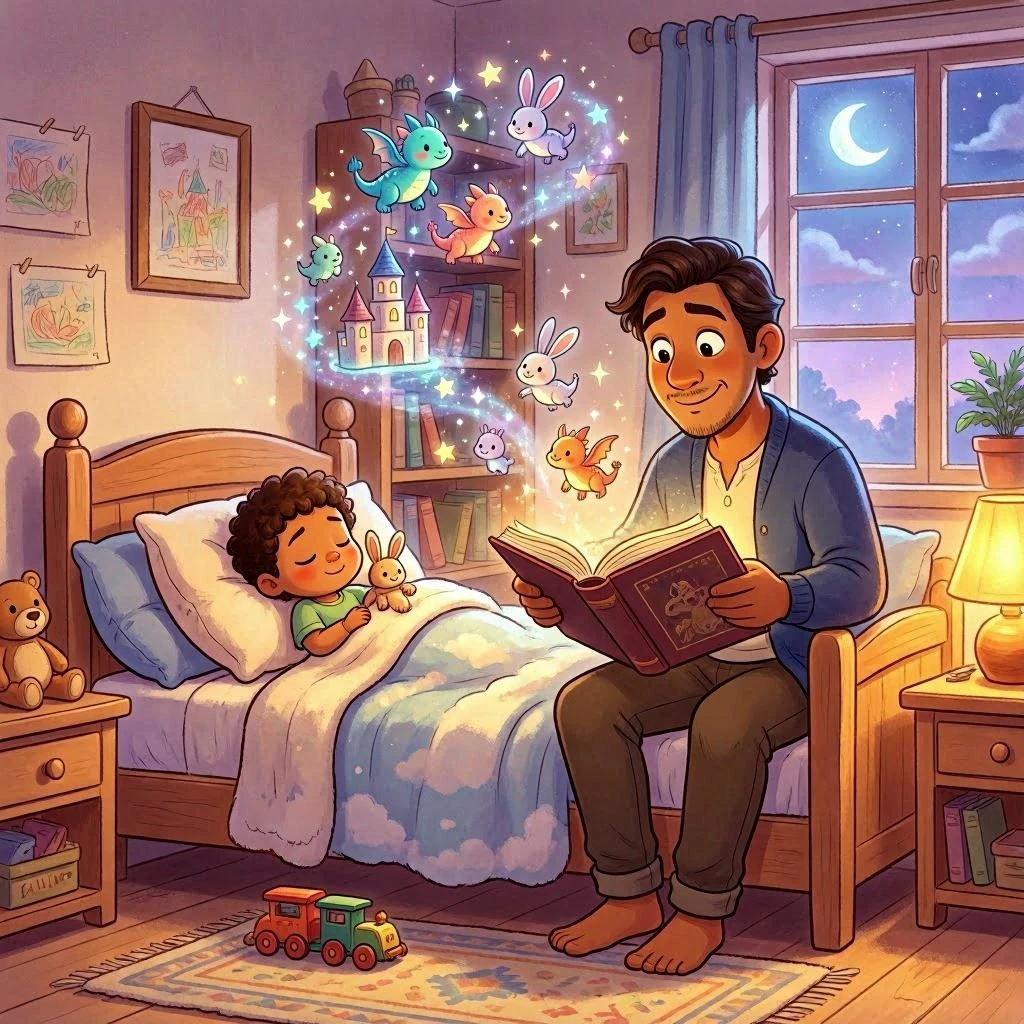
There is a moment, familiar to millions of parents, when the house grows quiet, the lamp casts a warm circle of light, and a child leans in close expecting a story. It feels like one of the simplest things in the world. Yet researchers who have spent decades studying child development will tell you that this small, soft ritual is one of the most cognitively powerful things you can do for a young mind. The nightly bedtime story is not a lullaby dressed up in words. It is a full-scale workout for the developing brain.
The Vocabulary Explosion
One of the most well-documented benefits of regular story reading is what linguists call the vocabulary gap. Children who are read to frequently encounter somewhere between four and seven times as many rare or advanced words as children who are not. This matters enormously because vocabulary at age five is one of the strongest predictors of reading comprehension at age ten, and reading comprehension at ten is a powerful predictor of academic performance throughout school. When a child hears the word "mysterious" in a story, sees the context around it, and feels the atmosphere the word creates, they are not just learning a definition. They are learning how language works.
The magic of story vocabulary is that it arrives in context. A child does not receive a word list. They receive a dragon who moves "stealthily" through a darkened forest, a princess who speaks "defiantly" to a king, a rabbit who is "bewildered" by the maze of hedgerows. The emotional charge of narrative makes the words stick. This is why children who are read to regularly often speak with a richness and precision that surprises adults who do not know their family reads together every night.
How Syntax Gets Absorbed
Beyond vocabulary, bedtime stories expose children to complex sentence structures that they would rarely encounter in everyday conversation. When you talk to a young child, you naturally simplify. You use short sentences, familiar words, direct requests. This is appropriate and loving. But books — even picture books — use language differently. They use subordinate clauses, passive constructions, and literary inversions. A child who hears these structures repeatedly, night after night, begins to internalize them without any conscious effort. By the time they encounter similar structures in their own reading, the patterns feel familiar rather than foreign.
Building the Listening Brain
There is another cognitive skill being sharpened during bedtime stories that often goes unremarked: sustained attention. To follow a story, a child must hold earlier information in working memory while absorbing new information, predict what might happen next, update those predictions as the plot develops, and stay engaged through passages that are not immediately stimulating. This is, in almost every respect, the same cognitive process required to follow a lecture, understand a complex argument, or work through a multi-step math problem.
Children who are read to regularly develop what researchers call narrative comprehension skills — the ability to track cause and effect, understand character motivation, and follow a sequence of events across time. These skills transfer directly to academic tasks. A child who can follow the plot of a multi-chapter story is much better equipped to follow the logical structure of a science explanation or a historical account.
The Role of Repetition
Parents who have read the same picture book forty or fifty times know the weary feeling of turning that cover page again. But repetition is not boring to a young child — it is deeply instructive. Hearing the same story multiple times allows a child to move from basic comprehension to deeper processing. On the first read, they are simply following the plot. On the fifth read, they notice the language. On the tenth, they begin to anticipate and feel the pleasure of knowing what is coming. On the twentieth, they may begin to notice subtle details — an expression on an illustrated face, a clue hidden in an earlier page. This layered processing is excellent cognitive exercise.
Emotional Intelligence Through Narrative
Intelligence is not only linguistic and logical. Bedtime stories also build emotional intelligence — the capacity to understand and manage feelings, to empathize with others, and to navigate social complexity. Stories are fundamentally about characters who want things, face obstacles, feel disappointed, make choices, and deal with consequences. Every story is a case study in human emotional life.
Research in developmental psychology has shown that children who are exposed to a high volume of fiction show greater ability to understand other people's mental states — what researchers call a well-developed "theory of mind." They are better at reading social situations, more empathetic in peer conflicts, and more sophisticated in understanding why people do what they do. This is not accidental. Stories are the ancient technology humans developed for exactly this purpose: to imagine lives other than our own.
The Quiet Power of Routine
There is one final gift that the bedtime story gives a child, and it has less to do with cognition than with security. A nightly reading ritual tells a child that the world is predictable, that the people who love them will show up, and that the end of the day is a safe and gentle place. This sense of security — what attachment researchers call a secure base — is itself a powerful enabler of learning. Children who feel safe take intellectual risks. They ask questions. They try things they might fail at. They are curious rather than anxious.
So when you open a book tonight and feel the weight of a small head against your shoulder, know that you are doing something profound. The story you are reading is not just entertainment. It is an investment in a mind that is, even now, growing to meet the world.