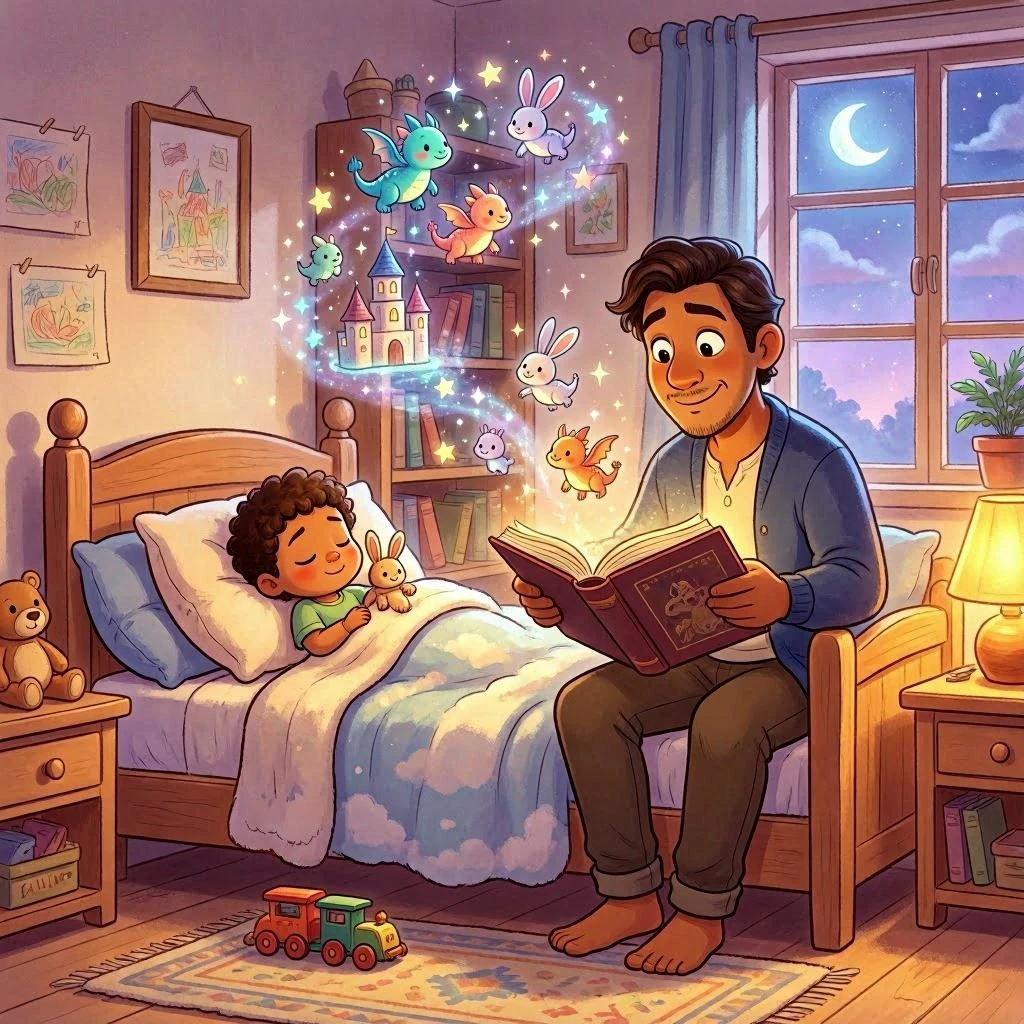
For most of human history, parents read to their children because it was a pleasant thing to do. It was cozy and connecting. It calmed the child before sleep. It passed down culture and stories from one generation to the next. These reasons were entirely sufficient. But over the last two decades, neuroscience has added a new layer of understanding to this ancient practice — and what researchers are finding in their brain imaging studies is genuinely remarkable.
When a caregiver reads aloud to a young child, something specific and measurable happens inside that child's skull. Brain circuits light up. Neural connections form and strengthen. Regions that process language, emotion, imagery, and memory are activated simultaneously in ways that ordinary conversation does not reliably produce. Reading aloud to a child is not simply a delivery mechanism for stories. It is a neurological event.
What Brain Scans Reveal
In a landmark series of studies conducted at Cincinnati Children's Hospital, researchers used functional MRI to scan the brains of young children aged three to five while the children listened to age-appropriate stories. The results were striking. Children who came from homes with higher levels of reading activity showed significantly greater activation in the areas of the brain associated with semantic processing — the extraction of meaning from language. They also showed greater connectivity between the language network and the visual processing network, suggesting that their brains were better at forming mental images from words alone.
Perhaps most significantly, the scans showed that children who were read to more showed higher activation in the left parietal-temporal-occipital association cortex — a region critical for integrating sounds with meaning. In plainer terms, their brains were more efficient at turning words into understanding. And this difference was visible years before those children would be expected to read on their own.
The Sound of a Familiar Voice
The neuroscience becomes even more interesting when researchers examine not just what is being read, but who is doing the reading. It turns out that the identity of the reader matters. When children hear a story in their primary caregiver's voice — the voice they have been hearing since before birth, the voice that signals safety and nourishment and love — the emotional processing centers of the brain are more actively engaged. The amygdala and the anterior cingulate cortex, regions involved in emotional regulation and social processing, show elevated activity.
This is not a trivial finding. It means that the emotional warmth of being read to by someone you love is not separate from the cognitive benefits — it amplifies them. The security and attachment that a child feels during a shared reading session appears to make the brain more receptive to the language and story being delivered. A bedtime story read by a loving parent is neurologically different from the same story delivered by a screen or a stranger.
Language Networks and the Literacy Bridge
One of the most consequential aspects of reading aloud is its role in building what linguists call phonological awareness — the ability to hear and manipulate the individual sounds of language. This skill is the single strongest predictor of later reading ability. Children who can identify rhymes, break words into syllables, and hear individual phonemes are dramatically more likely to become fluent readers than children who cannot.
Reading aloud contributes to phonological awareness in ways that are subtle but powerful. Rhyming stories teach children to hear the patterns of sounds in language. Books with rhythmic, repetitive language — the kind children beg to hear again and again — train the auditory cortex to pick out the fine-grained sound distinctions that reading requires. Even simple picture books, read with expression and attention, are building the neural architecture of literacy.
Print Awareness and the Concept of a Book
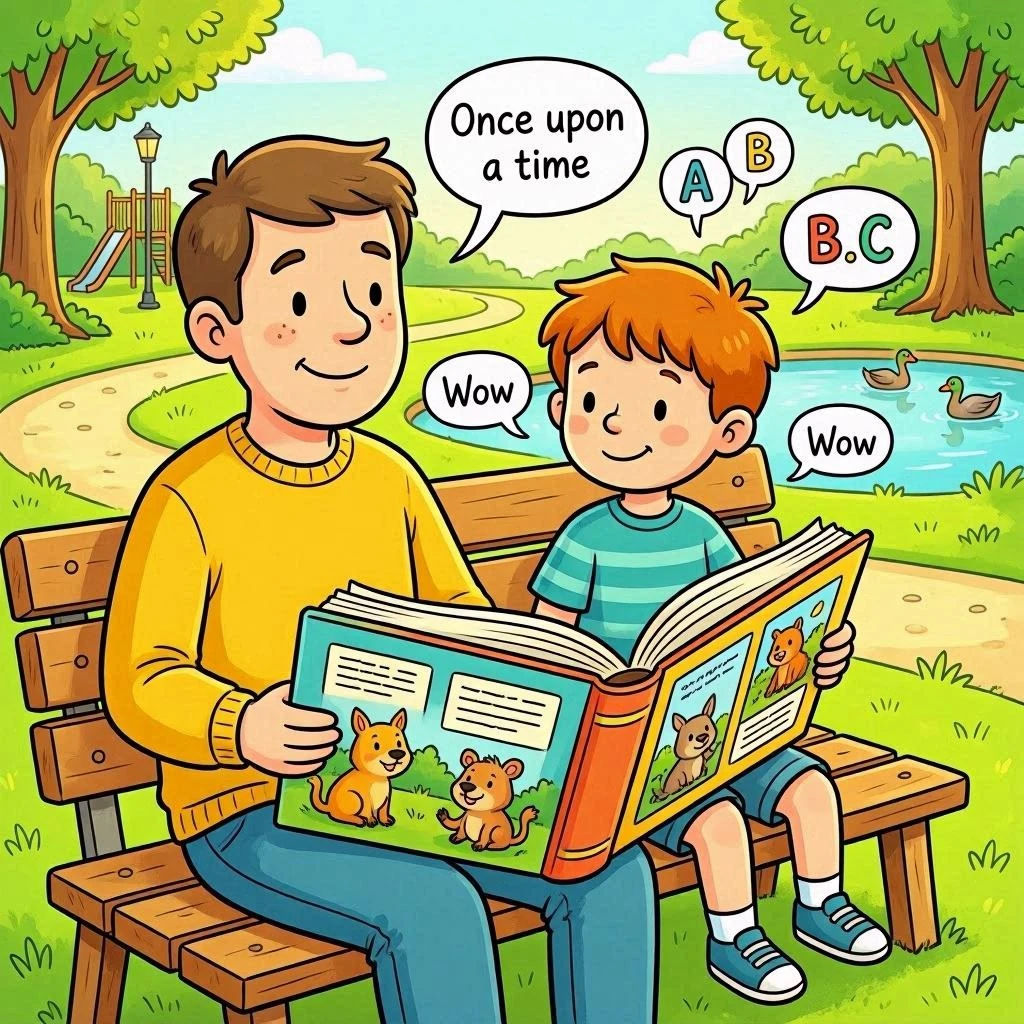
When a child sits beside a reader and watches them track words from left to right, turn pages at the end of a sentence, and occasionally pause to point out a word or a letter, that child is absorbing something fundamental: the concept of print. They are learning that those marks on the page correspond to the words being spoken. They are learning that text runs in a particular direction. They are learning that a book has a beginning, a middle, and an end. These seem like obvious things, but they must be learned — and a child who has had thousands of hours of lap-time with books learns them deeply and intuitively before formal schooling ever begins.
The Default Mode Network and Imagination
There is a region of the brain called the default mode network that is active when we daydream, imagine, remember, and simulate other people's experiences. This network is central to creativity, empathy, and the kind of self-reflective thinking that underlies emotional intelligence. Researchers have found that engaging with narrative — both reading and listening to stories — specifically activates the default mode network in ways that other forms of information consumption do not.
When your child listens to a story, they are not passively receiving information. They are actively constructing a mental world. They are imagining what the characters look like, how the forest smells, what the dragon's voice sounds like. This imaginative construction is a form of cognitive exercise that strengthens the default mode network and all the capacities it supports. The child who has spent thousands of hours imagining story-worlds enters adulthood with a richer, more flexible imagination.
The Long Arc of the Evidence
The research on reading aloud is not a collection of small, isolated studies. It is a decades-long body of converging evidence from linguistics, developmental psychology, neuroscience, and education research, all pointing in the same direction. Children who are read to frequently have larger vocabularies, stronger phonological awareness, better narrative comprehension, more developed theory of mind, and greater emotional regulation. They are more likely to enjoy reading independently, more likely to seek out books for pleasure, and more likely to perform well academically across subjects.
None of this requires expensive materials or special training. It requires a book, a child, and someone willing to read. The voice that changes a child's brain might already be your own.