There is a scene in the Brothers Grimm tale of Hansel and Gretel that has disturbed parents for centuries: two young children, abandoned in a forest by their own parents during a famine, nearly cooked and eaten by a witch before escaping through their own courage and cleverness. It is a terrible story, in the precise and original sense of the word. It is full of terror. And yet it has survived for hundreds of years, crossing borders and language barriers, passed from grandmother to grandchild across countless generations, because children recognize something true in it — something that speaks directly to the fears and hopes that live at the center of childhood experience.
We live in an age that is suspicious of this kind of story. We have been taught to protect children from difficulty, to sand the edges off narratives, to replace darkness with reassurance. The sanitized fairy tale, scrubbed of its shadows and ambiguities and given a tidy lesson at the end, is now the cultural norm. And yet child psychologists, educators, folklorists, and developmental researchers are increasingly unified in their concern about this trend. The fairy tale, in something close to its original form, is not just entertaining — it is developmentally necessary.
What Fairy Tales Understand About Childhood
The great fairy tales did not arise from a committee trying to educate children. They arose from the accumulated storytelling wisdom of communities trying to help their youngest members understand the world. They were shaped, over centuries, by what children responded to — what frightened them, what comforted them, what they needed to hear. The result is a body of story that is, in certain profound ways, more honest about childhood than almost anything written in the modern era.
Children already know that the world is not entirely safe. They already know that parents can be absent or ineffective. They already know that there are forces in the world — illness, loss, cruelty — that they cannot control. What fairy tales offer is not protection from this knowledge, but a framework for processing it. In the story, the child — or the child-like protagonist — faces these fears and navigates them. The witch is defeated. The treasure is found. The transformation is achieved. The child listening to the story does not literally believe they will be visited by a fairy godmother. But they absorb the emotional truth: that difficulty is survivable, that cleverness and courage matter, that the story does not have to end with defeat.
The Psychology of Symbolic Distance
One reason fairy tales work so powerfully on the young mind is that their strangeness provides what psychologists call symbolic distance. The fear is real, but it is wrapped in fantasy. A child who is anxious about being left out by friends can find their experience mirrored in a story about a third child who is dismissed by their two older siblings — and because the story is fantastical, they can engage with the emotional content without becoming overwhelmed by it. The magic and the metaphor act as a kind of protective layer, allowing the child to approach feelings that would be too intense to face directly.
This is why the child psychologist Bruno Bettelheim, in his influential 1976 work "The Uses of Enchantment," argued that children need fairy tales precisely because these tales do not try to reassure them falsely. Bettelheim observed that children are far more comforted by a story that acknowledges the difficulty of their situation and then shows a path through it than by a story that pretends the difficulty does not exist. The fairy tale says: yes, this is hard; yes, the forest is dark; yes, the witch is real. And then it says: and here is how you find your way through.
Fairy Tales in a Digital World
The argument for fairy tales has only grown more urgent in the digital age, and for reasons that go beyond child psychology. We live in an environment of unprecedented narrative abundance. Children today are surrounded by stories — in films, in games, in social media, in streaming platforms that offer an effectively unlimited supply of content. And yet much of this content is optimized not for emotional depth or symbolic richness, but for immediate engagement. It is designed to be maximally stimulating and minimally demanding. It is built to capture attention rather than to nourish imagination.
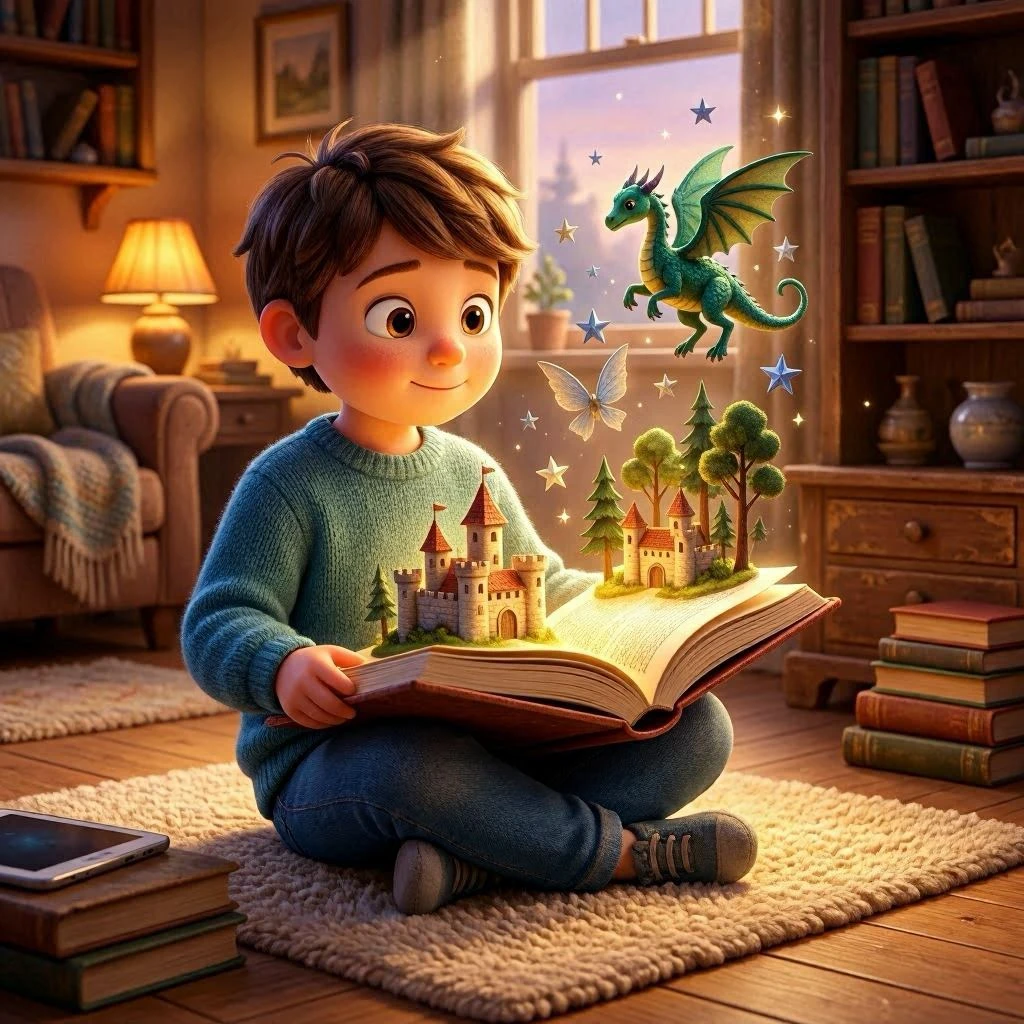
Fairy tales ask something different of their audience. They ask the child to slow down, to tolerate ambiguity, to sit with a story that does not resolve immediately into comfort. They ask the child to imagine the forest, to hear the wolf's voice, to feel the cold of the cottage in the woods — because the story does not show these things, it only suggests them. This imaginative participation is precisely the kind of cognitive and emotional exercise that hours of passive screen consumption does not provide.
Oral Telling Versus Reading
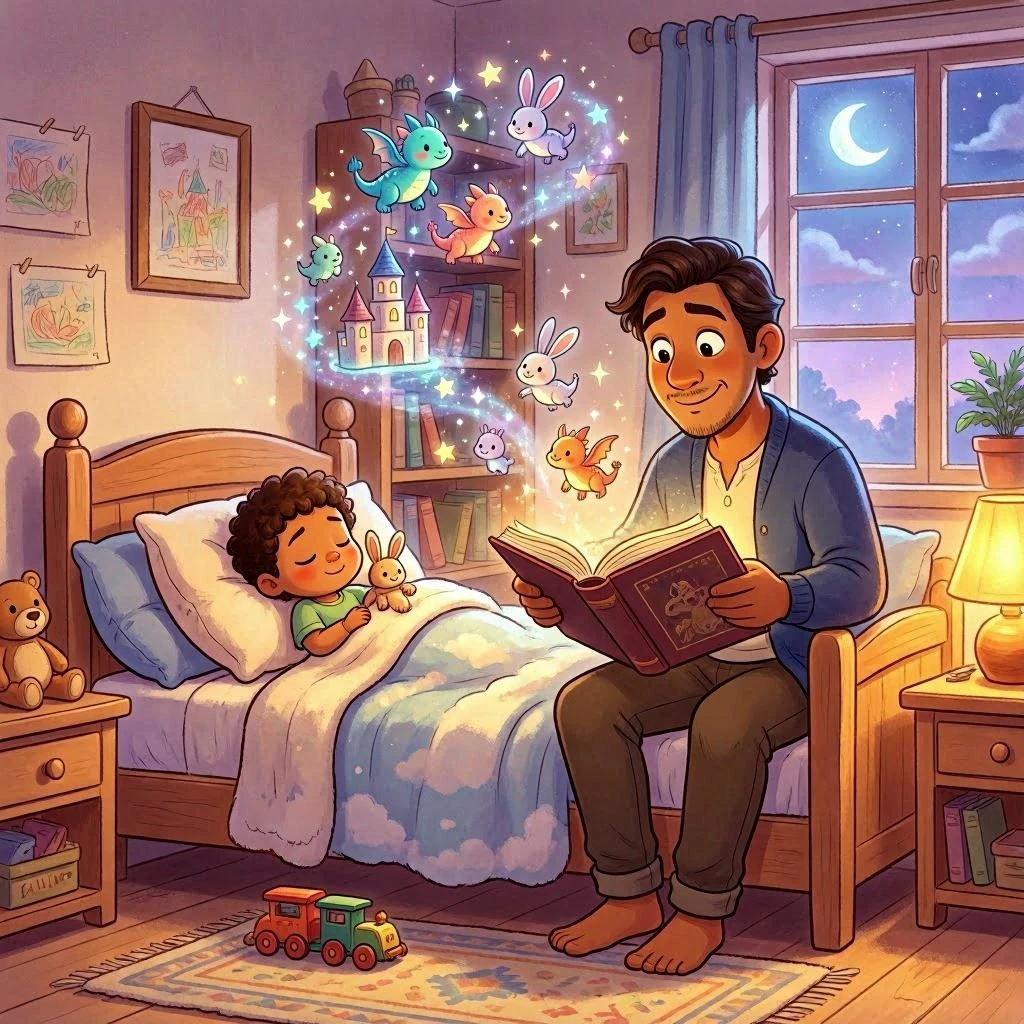
There is a difference worth noting between reading a fairy tale from a book and hearing it told aloud without a text. Both are valuable, but oral telling has a particular power. When a story is told rather than read, the teller and the listener are in an immediate relationship. The teller adjusts the pacing to the child's reactions, lingering over passages that seem to grip, moving more quickly through those that do not. The child, unanchored from an illustration, must generate their own images. And the story lives, as it did for all of human history before the printing press, in the air between two people rather than on a page.
Parents who feel uncertain about reading aloud should know that they need not perform perfectly. The imperfections of a parent's telling — the pauses, the invented details, the gentle questions asked mid-story — are part of the gift. They tell the child that this story belongs to us, here, together, tonight.
Which Tales to Tell
Not all fairy tales are created equal, and not all versions of any given tale are equally valuable. The richest versions are usually those closest to the oral tradition — those that retain their moral complexity, their darkness, and their strangeness. The versions that have been softened for very young children have their place, but as children grow, they are ready for more. A six-year-old can handle the wolf eating grandmother. An eight-year-old can handle the prince not arriving in time. A ten-year-old can handle a story in which the ending is not fully resolved.
The fairy tale tradition includes stories from every culture on earth. The tales of West Africa, Japan, the Middle East, Eastern Europe, and the Indigenous Americas are just as powerful and just as developmentally rich as the Germanic tales that dominate the Western canon. Introducing children to fairy tales from many traditions is not just a gesture toward diversity — it is an expansion of the child's imaginative world, a demonstration that the human struggle with fear and hope and transformation is genuinely universal.
In an age of optimized content and algorithmic entertainment, the fairy tale remains stubbornly, irreducibly human. It was made by human hands and human voices, shaped by human fears and human hopes, and it speaks to something in a child that no algorithm has yet figured out how to replicate. That is precisely why it still matters.